
India Job Crisis 2025: What Experts Predict for 2026
Is India Entering a Job Crisis? What Experts Predict for 2025–26
By TheMotoMint Insights Desk
Reading time: 8–10 min
Date: 27-11-2025
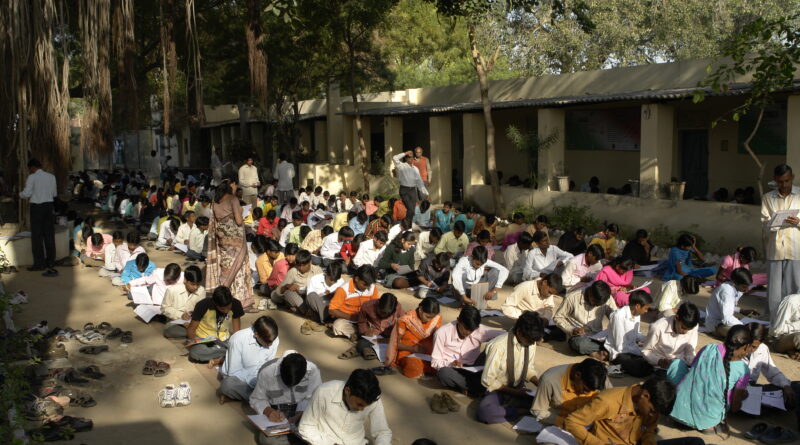
Young graduates queue up outside a government exam centre in a major Indian city, hoping for one of the few secure jobs available. Behind India’s growth story, an uncomfortable question is growing louder: Are there enough jobs for everyone?
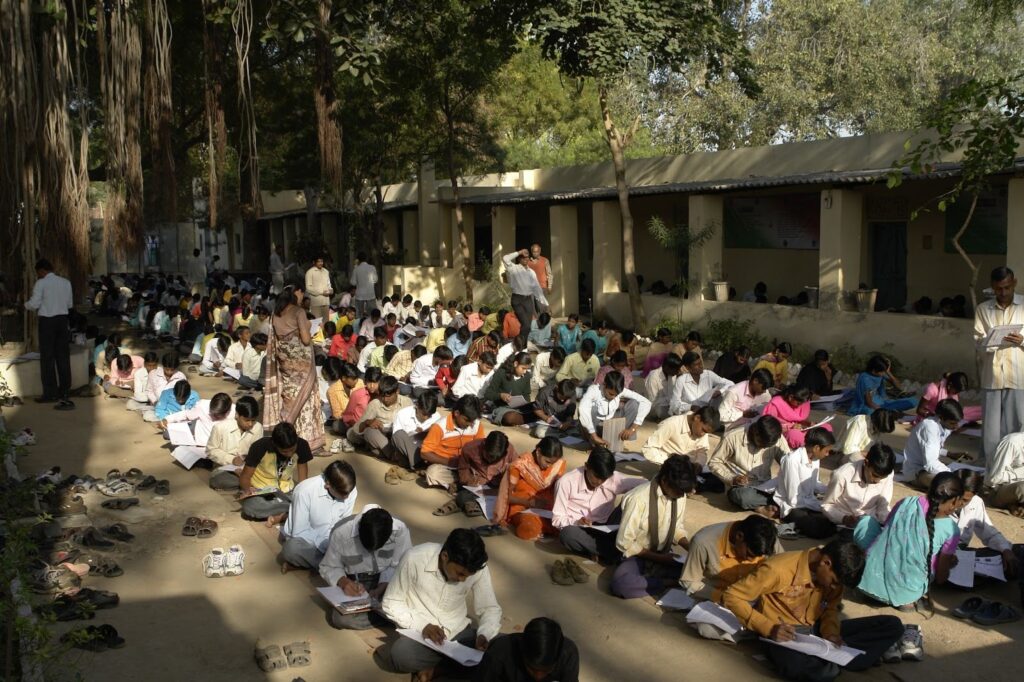
Exams in Jaura, India by Yann Forget,
via Wikimedia Commons, licensed under
CC BY-SA 4.0 — https://creativecommons.org/licenses/by-sa/4.0/
(Changes made: none)
In a nutshell
- India is still among the world’s fastest-growing major economies, but job creation is not keeping pace with the number of people entering the workforce.
- Youth and educated unemployment are emerging as the biggest pressure points, even while official unemployment rates look “manageable”.
- A mix of skill gaps, slow manufacturing growth, informality and automation is creating what many fear could turn into a jobs crisis.
- Without deeper reforms in education, skilling, labour laws and industrial policy, 2025–26 may bring more underemployment than prosperity.
India’s jobs picture today
Image License- Pixabay
Over the last decade, India has built a powerful macro story:
rising GDP, booming stock markets, global companies shifting from China, and a growing reputation as a tech and services hub.
On paper, the overall unemployment rate doesn’t look disastrous. Depending on the dataset and period, it often sits in the 4–6 percent range. Rural employment is sometimes cushioned by agriculture and public works schemes.
But headline numbers do not tell the full truth.
- Youth unemployment is significantly higher than the overall average.
- Many degree-holders are in low-paid or unrelated jobs, or preparing endlessly for competitive exams.
- A big share of new jobs are informal – contract, gig work, seasonal, or without social security.
In other words, India does not just have an unemployment problem.
It has a quality-of-jobs problem.
Facts & figures
- Population: ~1.4+ billion
- Labour force: roughly 500–600 million people
- Share of workforce in agriculture: around 40–45%
- Manufacturing share of GDP: hovering near 13–16%
- Share of services in GDP: 50%+
- Millions of youth enter the job market every year, but formal job creation lags behind.
These numbers tell a simple story:
India is big, young and energetic — but its job engine is still not firing on all cylinders.
Why growth alone is not enough
India is projected to grow at around 6–7 percent annually in the near term. That is impressive compared to many other economies.
But for jobs, experts say this may not be enough.
- To absorb the huge number of new entrants into the workforce and reduce underemployment, India likely needs much faster and more inclusive growth.
- So far, growth has been driven heavily by services, finance, IT and consumption, which do not always create mass employment at the bottom and middle skill levels.
- Manufacturing, which historically generates large numbers of jobs in countries like China, Vietnam or Bangladesh, has not yet taken off at the scale India needs.
The result?
Growth is visible in company profits, stock indices and headline GDP,
but far less visible in household incomes, secure jobs and career ladders for ordinary young Indians.
Structural challenges behind the job stress
The jobs debate in India cannot be reduced to just “more hiring” or “more schemes”.
Beneath the surface lie deep structural issues.
1. Skewed sectoral composition
A large portion of India’s workforce is still in agriculture, even though the sector contributes a much smaller share to GDP. At the same time, services dominate GDP but cannot absorb everyone, especially those with low or mid-level skills.
This imbalance means:
- Too many people chasing too little value in agriculture
- Too few opportunities in labour-intensive manufacturing
- A services sector that is dynamic but not always inclusive
2. Manufacturing that never fully took off
For years, the dream has been “Make in India” – factories, exports, assembly lines and millions of industrial jobs. Progress has been patchy.
Challenges include:
- Complicated land acquisition processes
- Complex labour regulations in many states
- Infrastructure and logistics gaps, especially for smaller firms
- Policy uncertainty and compliance burdens for businesses
Instead of large, labour-intensive factories, India often ends up with:
- Capital-intensive plants that hire fewer people
- Or micro and small enterprises stuck at a small scale, unable to grow and absorb many workers.
3. Skill gap vs. degree overload
India produces an enormous number of graduates every year, but degrees don’t always equal employability.
- Many colleges are theory-heavy and outdated in curriculum.
- Practical skills, digital literacy, industry exposure and soft skills are often missing.
- Employers complain they cannot find “industry-ready” talent, even when there are plenty of resumes.
This leads to the classic paradox: We have jobless graduates and employers with vacancies they cannot fill.
4. Informal and gig-heavy employment
A growing chunk of jobs are now:
- Delivery work
- App-based gigs
- Short-term contracts
- Casual, daily wage labour
These can provide quick income, but usually lack:
- Job security
- Health benefits
- Pension or social security
- Skill growth or clear career paths
If not supported by policy, the gig and informal segment can become a trap – easy to enter, hard to escape.
5. Technology, AI and automation
Automation and AI tools are gradually entering:
- Manufacturing
- Retail
- Banking and services
- Even parts of white-collar work
Routine and repetitive tasks are the most at risk.
This doesn’t mean “no jobs”, but it does mean:
- Fewer low-skill roles
- Higher premium on advanced skills, adaptability and learning
Those who can work with technology will move ahead.
Those who can’t risk being left behind.
Scenarios for 2025–26
Most likely: Slow improvement, persistent stress
- Growth remains around 6–7 percent.
- Some new jobs appear in services, infrastructure and digital sectors.
- But youth underemployment and informal work remain high.
- The gap between high-skill winners and everyone else widens.
Moderately likely: Acceleration through targeted reforms
- Faster changes in skilling, manufacturing policy, ease of doing business.
- Stronger push for labour-intensive industries like textiles, electronics assembly, food processing.
- Colleges and industry collaborate more closely on internships, live projects and curriculum.
- Over time, more formal, decent-paying jobs are created, especially for mid-level skills.
Least likely (but most transformative): Big-bang structural reset
- A decisive, across-the-board set of second-generation reforms.
- Land, labour, education and trade policies made far more flexible and growth-oriented.
- Massive national mission for upskilling and apprenticeship.
- Manufacturing and services both expand in a way that pulls millions into stable, productive work.
This third scenario could change the jobs story completely —
but it demands political will, administrative capacity and social consensus.
What this means for young Indians
Whether or not a full-blown “jobs crisis” hits, one thing is clear:
The world of work in India is changing fast.
For students and young professionals, that means:
- Relying only on a degree is risky.
- Practical skills, portfolios, certifications and projects matter more than ever.
- Comfort with technology, data, AI tools, digital platforms will separate winners from the rest.
- Side projects, freelancing, entrepreneurship and internships can be as valuable as marksheets.
The coming years may be tough, but they also open space for those who:
- Learn continuously
- Adapt quickly
- Build real, demonstrable skills
- Solve real problems — locally or globally
Conclusion
India isn’t facing a full job crisis yet, but the warning signs are clear. The economy is growing, but many young people still struggle to find stable and well-paid work. To secure a better future, India must focus on skill development, stronger manufacturing, and more quality jobs. The next few years will determine whether our young population becomes the country’s biggest strength or its biggest challenge.
About TheMotoMint Insights Desk
TheMotoMint brings you sharp, easy-to-understand analysis on economy, careers, technology, automobiles and global trends — helping students, job seekers and professionals stay ahead of the curve.